 EN

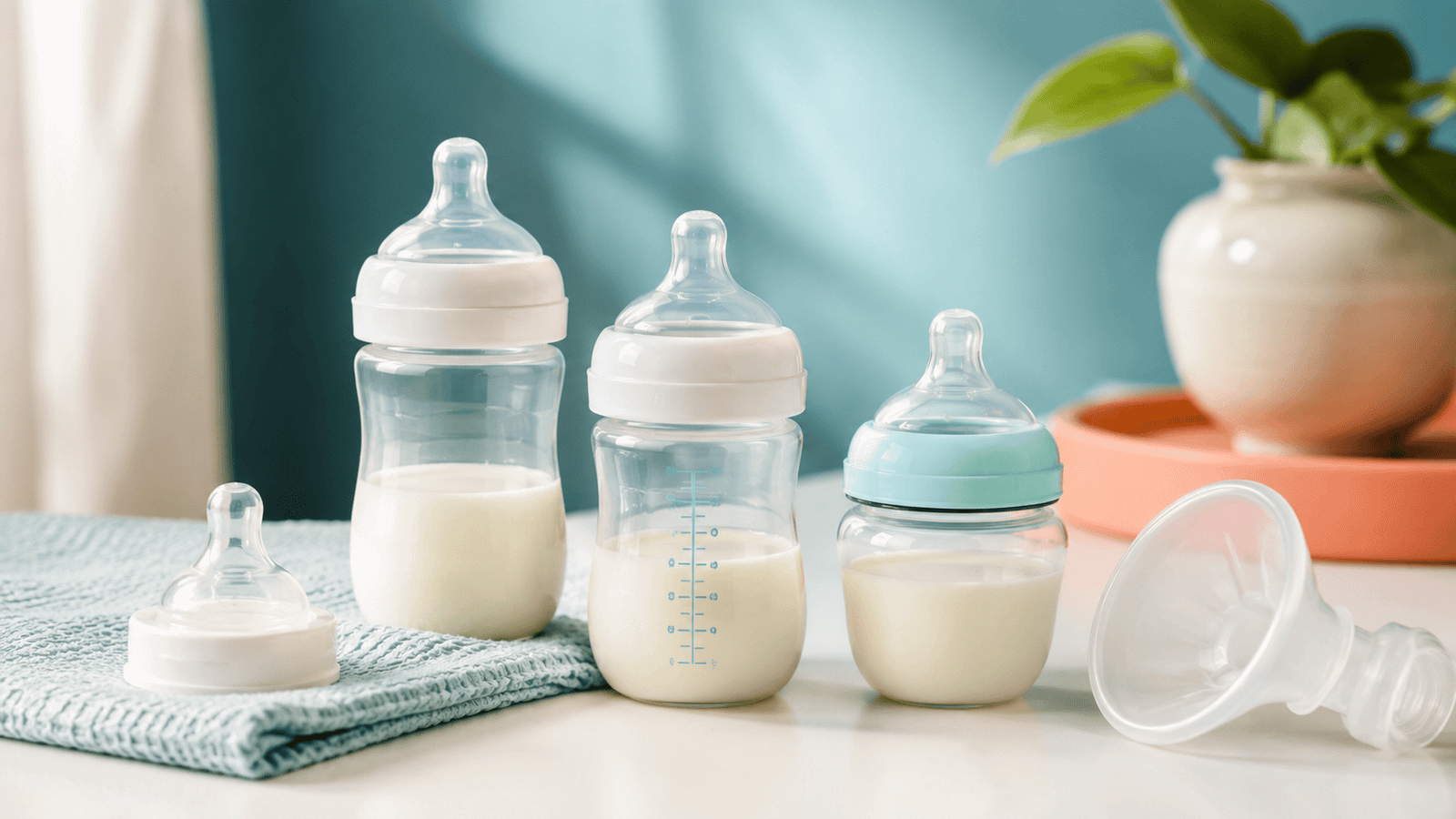
Baby bottles look like a simple registry purchase until you start comparing them.
There are narrow bottles, wide bottles, glass bottles, plastic bottles, silicone bottles, vented bottles, angled bottles, and bottles with several small internal parts. Then come the nipples. Brands offer different shapes, materials, and flow levels, often with claims about reducing gas or feeling more like breastfeeding.
For a mixed-feeding household, the decision can feel even more important. Your baby may breastfeed at some feeds, receive pumped milk at others, and drink formula at another point in the day. You may also pump directly into bottles, send bottles to daycare, or share feedings with a partner.
That does not mean you need an elaborate bottle system.
In fact, the safest buying strategy is usually to start smaller.
When choosing bottles for mixed feeding, focus on how well a bottle fits your baby’s feeding skills and your household routine. Consider nipple flow, cleaning, pump compatibility, bottle size, storage, and how many parts you will need to wash every day.
Then let your baby help make the final decision.
A bottle that looks perfect on a registry may not become the bottle your baby prefers. For that reason, buying a large set before your baby has used it can create more waste than convenience.
Start With a Few Bottles, Not a Full Cabinet
One of the most useful things first-time parents can do is resist the large starter set.
You may eventually need several bottles. However, you do not need twelve identical bottles before you know whether that bottle works well for your baby.
The American Academy of Pediatrics notes that manufacturers make many claims about bottle and nipple designs. However, there is not strong evidence that one bottle style is best for all babies. In practice, some trial and error may be necessary.
That is especially relevant for mixed feeding.
A baby who breastfeeds comfortably may respond differently to different nipple flows. Another baby may accept almost anything. Some babies care about nipple shape, while others seem much more sensitive to how quickly milk comes out.
Therefore, consider starting with a small number of bottles from one or two systems.
You might begin with two or three bottles rather than an entire collection. Use them for several feeds and watch what happens.
Does your baby feed calmly? Does milk leak around the mouth? Does the baby appear overwhelmed by the flow? Is feeding frustratingly slow? Can your partner assemble the bottle correctly at 3 a.m.? Can you clean every part without becoming annoyed?
Those details matter.
Once you find a system that works for both the baby and the adults, buy enough bottles to support your normal day.
This approach may look less organized during pregnancy, but it often creates a better system after birth.
Pay More Attention to Nipple Flow Than Marketing Claims
Bottle packaging often emphasizes nipple shape.
You will see terms such as “breast-like,” “natural,” “wide latch,” or “designed for breastfeeding babies.”
Those descriptions can be useful for understanding the product. Still, they should not be treated as a guarantee that a baby who breastfeeds will automatically accept that bottle.
Flow deserves just as much attention.
The CDC recommends holding a bottle at an angle rather than vertically so milk does not simply pour into the baby’s mouth. It also recommends allowing pauses and watching the baby’s hunger and fullness cues instead of encouraging the baby to finish every bottle. Those practices give the baby more control over the feeding.
That is useful in any bottle-feeding household. It can be especially relevant when a baby moves between breast and bottle.
A faster nipple is not automatically a better nipple.
Likewise, there is no prize for moving through flow levels quickly.
If your baby drinks comfortably from the current nipple, you do not need to increase the flow simply because a package associates another level with your baby’s age.
Instead, watch the feeding.
If milk seems to arrive faster than your baby can comfortably manage, discuss whether a slower flow or feeding adjustment may help. If feeds become consistently difficult, unusually long, or stressful, talk with your pediatrician, lactation professional, or feeding specialist rather than repeatedly changing equipment on your own.
The right flow is the one that allows your baby to feed effectively and comfortably.
Think About the Entire Feeding System, Not Just the Bottle
For a household that pumps, bottle compatibility can save a surprising amount of work.
Check your breast pump before you buy a large bottle set.
Some pumps connect directly to certain bottle types. Others require an adapter. In some systems, you may pump into one container and then transfer the milk into another bottle for feeding.
None of those options is inherently wrong.
However, transfers create additional parts and steps.
If you pump several times a day, direct compatibility may make your routine easier. You can pump into a container, store the milk appropriately, and use compatible parts without repeatedly moving milk between containers.
Still, do not choose a bottle only because it attaches to your pump.
The feeding bottle also has to work for your baby.
Sometimes an inexpensive adapter creates a better compromise than committing to a bottle your baby does not feed from comfortably.
Before buying, check four things: your pump connection, storage lids, bottle nipples, and whether adapters are required.
Then imagine the complete workflow from pumping to refrigerator to feeding to washing.
The best bottle system is usually the one with fewer unnecessary steps.
Bottle Size Matters Less Than Parents Often Think
Many bottle systems offer a smaller bottle for newborns and a larger version for older babies.
The small bottle can be convenient during the early months because it is compact and easy to handle. It can also make small quantities easier to see.
However, you do not necessarily need a large collection in both sizes.
Babies’ feeding amounts change over time. Therefore, a household that uses bottles frequently may eventually find larger bottles more practical.
For mixed-feeding families, the decision depends partly on how many feeds happen at the bottle.
If your baby breastfeeds most of the time and gets one occasional bottle, you may use a small bottle for quite a while.
If bottles account for several daily feeds, larger bottles may become useful sooner.
Consider your expected routine before buying both sizes in bulk.
Also remember that the markings on a bottle are convenient for everyday use, but feeding does not need to become a contest to reach a particular line.
The CDC advises parents to watch a baby’s cues and stop when the baby shows signs of fullness, even when milk remains in the bottle.
That principle matters more than owning a specific bottle capacity.
Count the Parts Before You Fall in Love With the Design
A bottle can look wonderfully sophisticated in the store and feel considerably less wonderful when you are washing six of them every night.
Some bottle systems contain only a bottle, nipple, collar, and cap.
Others add vents, membranes, inserts, valves, or other small components.
Those extra parts may serve a purpose. However, they also need to be disassembled and cleaned correctly.
The CDC recommends cleaning bottles after every feeding. Bottle parts should be taken apart so nipples, rings, caps, valves, and other components can be cleaned thoroughly. Dishwasher-safe items can be cleaned in the dishwasher according to CDC guidance, while handwashing requires a dedicated basin and brush rather than placing feeding items directly in the sink.
Therefore, look at a bottle before buying it and mentally take it apart.
How many pieces are there?
Are the small parts easy to lose?
Can you reach every surface with a brush?
Are the parts dishwasher-safe?
Can another caregiver assemble the bottle without instructions?
If you will use one bottle occasionally, a complex system may not bother you.
If you expect six bottle feeds a day, every additional piece becomes six more pieces to manage.
Convenience becomes more valuable with repetition.
Do Not Assume an “Anti-Colic” Bottle Will Solve Every Feeding Problem
Gas and fussiness are common concerns, so many bottles are marketed around air reduction or venting.
Some families do find a particular system helpful. However, bottle design is only one part of feeding.
The AAP notes that trying different bottles and nipple flows may sometimes help babies who swallow more air. At the same time, there is no single bottle design that can guarantee a gas-free baby.
That is another reason not to buy a large set based on one marketing claim.
If your baby has significant feeding discomfort, persistent vomiting, choking, coughing during feeds, poor weight gain, or another feeding concern, equipment shopping should not replace medical evaluation.
Talk with your pediatrician.
A different bottle may occasionally help. A feeding problem may also have nothing to do with the bottle.
Choose Material Based on How You Will Use the Bottles
Parents usually encounter three main bottle materials: plastic, glass, and silicone.
Each creates a different household experience.
Plastic bottles are typically lightweight. That can make them convenient for daycare, diaper bags, travel, and middle-of-the-night feeds. If you choose plastic bottles, follow the manufacturer’s instructions for cleaning, heating, replacement, and dishwasher use.
Parents sometimes worry specifically about BPA when choosing plastic bottles. In the United States, FDA regulations no longer provide for the use of BPA-based polycarbonate resins in baby bottles and sippy cups. The FDA changed those regulations after the industry abandoned those uses.
Glass bottles are heavier, but some families prefer their durability and the ease of seeing whether the bottle is completely clean. Protective sleeves may be available for some products.
However, check your childcare policy before building a glass bottle collection. Some daycare settings may restrict or have specific rules for glass containers.
Silicone bottles are another option. They can feel lighter and softer than glass, although the exact design and cleaning requirements vary by manufacturer.
There is no need to turn bottle material into a moral decision.
Choose a food-contact product intended for infant feeding, follow its instructions, and think about how it works in your household.
A bottle that becomes inconvenient every time you leave home is unlikely to remain your favorite for long.
Consider Daycare Before You Buy Eight Bottles
If your baby will attend daycare, ask the provider about bottles before you invest heavily.
Childcare centers may have rules about labeling, preparation, bottle materials, storage, and whether bottles must arrive fully assembled.
They may also ask you to send one bottle for each expected feed rather than reusing bottles during the day.
That can change how many bottles you need.
For expressed breast milk, the CDC recommends labeling milk with the date it was expressed. When milk goes to childcare, the container should also be labeled with the child’s name.
Therefore, look at how easy a bottle is to label.
Can you write on the cap? Will you need removable labels? Are several identical bottles easy to tell apart when they belong to different children?
Also ask the daycare how bottles are stored and returned.
You may discover that your elegant home system becomes frustrating when six individual bottles need labels, caps, cooler storage, and transport every morning.
The best daycare bottle is often the one that creates the least daily friction.
Decide How Many Bottles You Need From Your Real Routine
There is no universal number of bottles that every mixed-feeding household needs.
The right number depends on how often your baby receives a bottle and how often your household wants to wash them.
Suppose your baby typically has four bottle feeds during a normal day.
Owning only two bottles means someone needs to wash bottles repeatedly before the day is over.
Owning fifteen bottles may simply fill the cabinet.
A practical approach is to have enough bottles for the bottle feeds you normally expect, plus a small buffer.
For a baby who receives bottles occasionally, that may be only three or four.
For a baby who receives most feeds by bottle, six to eight may be more convenient.
Those numbers are examples, not rules.
Your dishwasher also matters.
A household that runs the dishwasher every night may prefer a different number from a household that washes everything by hand.
Childcare changes the calculation again. If five bottles leave for daycare each morning, you may want another clean set at home.
Do the math after you know which bottle works.
First find the system. Then build the inventory.
Buy Extra Nipples More Carefully Than Extra Bottles
Once you find a bottle your baby uses comfortably, replacement nipples may become more useful than buying more bottle bodies.
However, check the manufacturer’s guidance before stocking several future flow levels.
Your baby may not need them on the schedule printed on the package.
Also inspect nipples and other bottle components regularly. Follow the manufacturer’s recommendations for replacement, and replace damaged parts.
If you change nipple flow, watch the next several feeds.
Do not assume that a feeding problem automatically means you need a faster nipple.
Sometimes the issue is positioning. Sometimes the baby needs breaks. Sometimes the nipple is damaged or blocked. In other cases, a feeding assessment may be useful.
Changing one thing at a time makes it easier to understand what actually helped.
A Bottle Warmer Is Optional
Bottle buying often leads directly to bottle-warmer shopping.
You may not need one.
Neither breast milk nor infant formula has to be served warm. The CDC states that formula does not need to be warmed before feeding. Expressed breast milk can also be served cold or at room temperature if your baby accepts it.
Some babies and parents still prefer warm milk.
If so, you can warm a sealed bottle or milk container using warm water according to current handling guidance and manufacturer instructions.
Do not microwave breast milk or formula.
Microwaves can heat unevenly and create hot spots that may burn a baby’s mouth.
This means a bottle warmer is a convenience product, not a feeding requirement.
Before buying one, see whether your baby actually cares about milk temperature.
You may eliminate another countertop appliance.
Plan for Cleaning Before You Plan for Storage
The number of bottles you buy affects your kitchen.
So does the way you clean them.
The CDC recommends cleaning feeding items after each feeding. It also recommends daily sanitizing for extra germ removal when a baby is younger than 2 months, was born prematurely, or has a weakened immune system. For older, healthy babies, separate daily sanitizing may not be necessary when items are cleaned carefully after each use.
If your dishwasher can safely handle your chosen bottles, that may simplify the routine. Check both the bottle manufacturer’s instructions and the settings available on your dishwasher.
If you handwash, you will need enough counter space for cleaning and air-drying.
This is another reason that bottle complexity matters.
A system with many tiny valves takes up more drying space and requires more attention.
Before buying, look at your kitchen.
Where will dirty bottles wait?
Where will clean bottles dry?
Where will completely dry bottles be stored?
A bottle system is easier to maintain when those answers are obvious.
Mixed Feeding Also Means Managing Two Different Kinds of Milk
If your bottles may contain both expressed breast milk and formula, make sure every caregiver understands that storage rules are not interchangeable.
Prepared formula and expressed breast milk have different handling timelines.
According to current CDC guidance, prepared formula should generally be used within two hours of preparation and within one hour after a feeding begins. Formula left in the bottle after a feed should be discarded.
For freshly expressed breast milk, the CDC states that milk can generally remain at room temperature at 77°F or colder for up to four hours, in the refrigerator for up to four days, and in the freezer for about six months for best quality, although up to 12 months is acceptable. If the baby does not finish a bottle of breast milk, the leftover milk should be used within two hours after the feeding ends and then discarded.
Those rules can feel complicated when everyone is tired.
Therefore, make the household system simple.
Label stored milk. Keep feeding instructions accessible. If several adults prepare bottles, make sure they all use the same rules.
The bottle itself does not solve those logistics.
Organization does.
Think About Your Diaper Bag Too
A bottle that works beautifully at home may be awkward outside the house.
Before buying many of them, imagine packing two bottles into your diaper bag.
Are they unusually wide?
Do they fit the insulated section?
Do the caps stay secure?
Will several bottles take up most of the bag?
Does the bottle leak when it is carried sideways?
These are not glamorous specifications, but they affect daily use.
The same applies to travel.
A household that walks everywhere may value lighter bottles. Someone who drives most places may care less about weight.
Parents who frequently pump away from home may value pump compatibility more than parents who primarily breastfeed directly.
Again, there is no universal best bottle.
There is a bottle system that creates fewer problems in your particular routine.
Let Other Caregivers Test the System
Mixed feeding often means that more than one adult feeds the baby.
Use that advantage when evaluating bottles.
Ask your partner to prepare one.
Can they identify the correct nipple?
Can they assemble all the parts?
Can they tell which stored milk to use?
Can they wash the bottle correctly afterward?
If the system only works because one parent has memorized seven small details, it is not yet a household system.
This becomes even more important before returning to work or starting childcare.
A straightforward bottle routine makes it easier to hand feeding responsibilities to another trusted adult without giving a full tutorial every time.
Do Not Replace Feeding Cues With Bottle Measurements
One advantage of bottles is that you can see exactly how much milk is inside.
That can also become a source of unnecessary pressure.
Parents may start expecting the baby to finish a fixed number of ounces because that amount was poured into the bottle.
The CDC recommends a responsive approach instead. Hold your baby during the feeding, allow pauses, and stop when the baby shows signs of fullness. Do not prop the bottle or leave it in the baby’s mouth, and do not force the baby to finish it.
This matters for mixed feeding because breastfeeds do not come with visible ounce markings.
A baby can still regulate intake across different feeding methods.
The bottle measurement gives you information. It does not create a requirement.
If your baby’s intake, weight gain, feeding behavior, or hydration concerns you, discuss the pattern with your pediatrician rather than adjusting feeding goals based only on bottle markings.
What Deserves Your Money Before Baby Arrives?
For most mixed-feeding households, the initial bottle purchase can stay modest.
Buy a few bottles to test. Make sure you have appropriate nipples. Check whether the system works with your pump if that matters to you.
Then stop.
You do not necessarily need a sterilizer, bottle warmer, formula dispenser, elaborate drying system, multiple bottle sizes, and twelve bottles before the first feeding.
Some of those items may become useful.
Wait until you know which problem you are trying to solve.
The same principle applies to specialty bottles.
If your baby feeds comfortably from a simple bottle, there may be no reason to add a more complicated anti-colic system.
If a feeding challenge appears, talk with your pediatrician or feeding professional and adjust the equipment when appropriate.
Buying in response to a real need usually creates a better system than trying to predict every possible feeding problem during pregnancy.
A Practical Bottle Buying Plan
If you want a straightforward way to shop, start with only enough equipment to learn.
Buy two or three bottles from a system that fits your budget and basic needs. If you want to compare designs, test a second style rather than buying a large set.
Choose a slow or appropriate initial nipple flow based on the manufacturer’s guidance and your baby’s feeding needs. Check pump compatibility if you expect to pump often. Count the bottle parts and make sure you are willing to clean them after every use.
Then feed your baby.
Watch how the bottle works in real life.
Once you have found a good fit, buy enough for one typical day plus a reasonable buffer. Add another set if daycare, work, or your washing routine makes it useful.
That approach may require one additional shopping order after the baby arrives.
It may also prevent an entire cabinet of bottles that nobody uses.
Frequently Asked Questions About Bottles for Mixed Feeding
What bottles are best for mixed feeding?
There is no single bottle that works best for every mixed-fed baby. Look for an appropriate nipple flow, easy cleaning, practical size, pump compatibility when useful, and a design your baby feeds from comfortably.
Do breastfed babies need a special bottle?
Not necessarily. Products marketed as more breast-like may work well for some babies, but nipple shape alone does not guarantee that a breastfed baby will prefer a particular bottle. Start with a small number and test before buying a full set.
How many bottles do I need for mixed feeding?
It depends on how often your baby receives bottles. Occasional bottle feeding may require only a few. Families using several bottles each day may prefer enough for a full day plus a small buffer.
Should I buy 4-ounce or 8-ounce bottles?
Smaller bottles can be convenient during early feeds, while larger bottles may remain useful for longer. You do not necessarily need large sets in both sizes. Base the decision on how frequently your baby uses bottles and whether you want to buy another size later.
What nipple flow should I use for mixed feeding?
Start with a flow appropriate for your baby’s age and feeding skills, then watch how the baby feeds. A faster nipple is not automatically necessary as soon as the baby reaches a certain age. Ask your pediatrician or feeding specialist if feeds seem consistently difficult.
Are anti-colic bottles necessary?
No. Some families find vented systems useful, but no bottle can guarantee that a baby will not have gas or feeding discomfort. Consider the extra cleaning parts before buying a large set.
Do I need a bottle warmer?
No. Breast milk and formula do not have to be served warm. A warmer is optional if your baby or household prefers one.
Can I microwave a baby bottle?
No. The CDC advises against microwaving formula or breast milk because uneven heating can create hot spots and burn a baby’s mouth.
Are glass bottles better than plastic bottles?
Neither material is automatically best for every household. Consider weight, durability, cleaning, travel, and daycare requirements. Use products intended for infant feeding and follow manufacturer instructions.
Should my bottles match my breast pump?
They do not have to. Direct compatibility can reduce milk transfers and extra washing, but adapters may also work. Your baby’s ability to feed comfortably from the bottle remains important.
How often do baby bottles need to be cleaned?
The CDC recommends cleaning bottles and their parts after every feeding. Some babies also need daily sanitizing of feeding items, particularly babies younger than 2 months, babies born prematurely, and babies with weakened immune systems.
Can I use the same bottles for breast milk and formula?
A feeding bottle may generally be used for either when it is appropriate for infant feeding and properly cleaned. However, breast milk and formula have different preparation, storage, and leftover-use guidelines, so caregivers should know which rules apply to the milk inside.
Final Thoughts
Choosing bottles for mixed feeding does not require finding one perfect product before your baby arrives.
Start with a small number.
Pay attention to nipple flow, but do not assume faster is better. Check how many parts you will wash. Look at pump compatibility if pumping will be part of your routine. Think about daycare, your diaper bag, and where bottles will dry in your kitchen.
Most importantly, wait for real information before buying a large set.
Your baby will tell you something about the feeding experience. Your daily routine will tell you something else.
A bottle that works comfortably for the baby, cleans easily, and fits the way your household actually feeds is more valuable than one with the longest feature list.
Once you find that bottle, buy enough to make your routine easier.
Until then, keep the cabinet space.